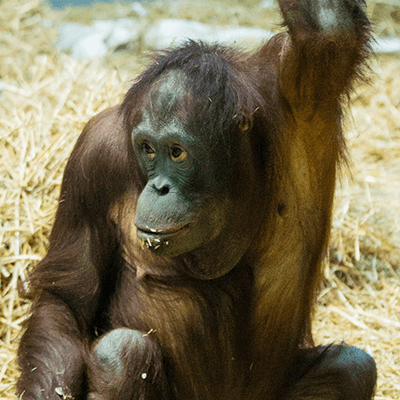
ORANGUTAN
Scientific Name: Pongo pygmaeus
IUCN Status: Endangered
Habitat: In the trees of the tropical rainforests of Borneo and Sumatra islands.
Diet: Fruits, nuts, bark, insects, leaves and eggs
Life Span: 35 years
Reproduction: Females give birth to a single offspring every 3 to 6 years. A baby orangutan will cling to its mother for up to 18 months or until the mother gives birth again.
Fact: Because an Orangutan spends most of its time in the trees, its arms are longer and stronger than any other ape.
CHIMPANZEE
Scientific Name: Pan troglodytes
IUCN Status: Endangered
Habitat: Chimpanzees nest in trees high above the ground in forests and savannas in Africa from Guinea to western Uganda and Tanzania.
Diet: Mainly fruit, but also buds, leaves, blossoms, bark, resin, honey, termites and ants. Chimpanzees occasionally eat other animals.
Life Span: 40 to 50 years
Reproduction: Beginning at 8 to 10 years of age, mature female chimps will have 1 to 2 offspring every 3 to 5 years.
Fact: Chimpanzees are the most skilled of the few animals that can use tools.
COLOBUS MONKEY
Scientific Name: Colobus guereza
IUCN Status: Least concern
Habitat: Tropical rain and montane (a moist ecological zone located near timberlines and usually dominated by evergreen trees) forests in Gabon, Equatorial Guinea and southwest Cameroon.
Diet: Young leaves, fruit, leaf buds and blossoms.
Life Span: Up to 20 years in the wild or 24-plus years in captivity.
Reproduction: Males reach sexual maturity at six years; females at four years. Each female gives birth to one young about every 20 months after a gestation period of 4-½ to 5-½ months.
Fact: Unlike most primates, the colobus monkey has no cheek pouches and its thumbs are nearly absent. ("colobus" is derived from a Greek word meaning "mutilated.")
WHITE-HANDED GIBBON
Scientific Name: Hylobates lar
IUCN Status: Endangered
Habitat: Upper forest canopy where there are lots of spreading branches that allow for continuous travel
Diet:Fruit constitutes 75% of diet, while the rest is plants and meat
Life Span: 35-40 years
Reproduction:Mates usually stay together for life and reproduce when they are fully grown at 12-13 years old.
Fact: Most gibbon species are threatened or endangered due to habitat loss
GEOFFROY'S MARMOSETS
Scientific Name: Callithrix geoffroyi
IUCN Status: Least concern
Habitat: Forests of southeastern Brazil
Diet: Fruits, insects, and plant gums
Life Span: 10 years
Reproduction: Each group of marmosets is made of a monogamous pair that breeds, and other helpers, often older offspring of the pair, who do not reproduce. Offspring are usually twins, and the male helps to raise young.
Fact: Geoffroy's marmosets participate in allogrooming, or social grooming that has a primary purpose of social interaction.
GOLDEN LION TAMARINS
Scientific Name: Leontopithecus rosalia
IUCN Status: Endangered
Habitat: Humid, dense coastal forests in southeastern Brazil
Diet: Highly varied diet, including spiders, insects, eggs, fruit, and even small birds and lizards
Life Span: 15 years
Reproduction: Tamarins live in groups with one breeding pair, and usually give birth to twins twice per year.
Fact: Golden lion tamarins can make a variety of sounds, and have at least 17 distinct calls, including clucking during foraging.