AFRICAN PENGUIN
Scientific Name: Spheniscus demersus
IUCN Status: Endangered
Habitat: Inhabit the southern coast shoreline of Africa. All penguins live either on or south of the equator.
Diet: Food primarily anchovies, sardines, horse mackerels and round herring,
supplemented by squid, shrimp and crabs.
Life Span: Ten years in the wild; 15-20 in captivity.
Reproduction: Blackfoot penguins start breeding at between two and six years, normally at four years, and they mate for life. The female lays one to three eggs twice a year with the male sharing the 39-day incubation period with the female.
Fact: While exploitation of the penguin eggs for food, habitat alteration and disturbance due to guano gathering has mostly ceased, current threats include competition with Cape Fur Seals for space or for food resources.
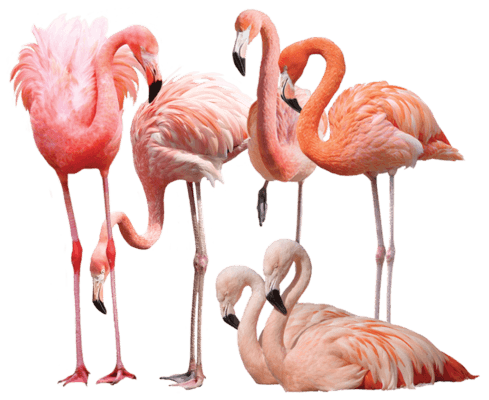
CARIBBEAN & AMERICAN FLAMINGO
Scientific Name: Phoenicopterus ruber
IUCN Status: Least concern
Habitat: Shallow salty lagoons and lakes in southern Europe, southwestern Asia, Africa, the West Indies and the Galapagos Islands
Diet: Insects, mollusks, worms, crustaceans, algae and protozoa
Life Span: An average of 20 years, and possibly twice as old in captivity
Reproduction: Breeding season is from April through August. Flamingos lay 1 egg at a time, and the chicks grow feathers about 7 weeks after they hatch.
Fact: What appear to be the flamingo's knees are actually its ankles, which bend backward when the bird sits down.
OSTRICH
Scientific Name: Struthio camelus
IUCN Status: Least concern
Habitat: Ostriches prefer open land, and are native to savannas in Africa
Diet: Plants and insects
Life Span: 30-70 years!
Reproduction: Territorial males will typically use hisses and other sounds to fight for a harem of two to seven females. The winner of these fights will breed with all the females in an area, but will only form a pair bond with the dominant female. The mating season beginning in March or April and ending sometime before September.
Fact: Ostrich eggs are HUGE! One ostrich egg equals up to 24 chicken eggs. And it takes approximately 2 hours to boil!
RHEA
Scientific Name: Rhea americana
IUCN Status: Near threatened
Habitat: Grassy plains from Bolivia and Brazil to central Argentina
Diet: A very healthy diet consisting of plants and fruit
Life Span: 30-40 years
Reproduction: Males are polygamous and hatch the eggs; several females use the same nest and a single male may hatch 50 eggs.
Fact: Their wings are large for a flightless bird and are spread while running, to act like sails or rudders. When pursued, rheas will out maneuver a predator by raising one wing and lowering the other, enabling them to turn very quickly.
EMU
Scientific Name: Dromaius novaehollandiae
IUCN Status: Least concern
Habitat: The emu inhabits open plains and brush in Australia
Diet: Roots and fruits
Life Span: 10-20 years
Reproduction: It lays its eggs, which are dark green and about 4 in long, in a scooped-out hole in the ground. Incubation takes almost two months and is accomplished entirely by the male, which also assumes care of the chicks.
Fact: This bird is peaceful and timid, and it is capable of running at considerable speed to elude attackers.
BLACK SWAN
Scientific Name: Cygnus atratus
IUCN Status: Least concern
Habitat: Fresh, brackish and salt water lakes, swamps and rivers
Diet: Water plants and grains
Life Span: Up to 40 years
Reproduction: Once they mate, swans remain together for life. Both partners share in building their nest, defending and incubating their eggs and caring for their young.
Fact: Swans will attack any human who intrudes on their nesting territory. Belligerent, ill-tempered and territorial, they will not tolerate other swans, except their mates and young. The general rule is for one pair of swans to occupy the same pond or stretch of stream for their 30 to 40 years life span.
PEACOCK
Scientific Name: Pavo cristatus
IUCN Status: Least concern
Habitat: Open forest, bushland, thorn forest and sometimes rainforest
Diet: Ticks, termites, ants, locusts, mice, plant parts, flower petals, seed heads, scorpions and other arthropods, reptiles, and amphibians
Life Span: 15 years in the wild, 40 years in captivity
Reproduction: Males do a very intricate mating dance to impress potential female mates.
Fact: Reaching heights of over three feet, an adult peacock's 'train' of tail feathers can be sixty inches in length.
BLUE & GOLD MACAW
Scientific Name: Ara ararauna x macao
IUCN Status: Least concern
Habitat: Palm swamps, woodlands and other semi-open wooded habitats in South America
Diet: They have a very strong beak for eating their natural foods, which include the kernel of hard nuts and seeds. Their strong beaks are even able to crack coconuts and macadamia nuts. In addition, they eat fruits and other vegetable matter.
Life Span: 35-50 years
Reproduction: Juveniles stay with their parents until they are three months old. They are mature and begin breeding at seven years of age.
Fact: Macaws are playful and inquisitive and are able to mimic human vocalizations very well!
GREAT HORNED OWL
Scientific Name: Bubo virginianus
IUCN Status: Least concern
Habitat: Widespread throughout forests and woodlands in North and South America
Diet: Rodents, hares, squirrels, skunks, various birds such as geese, grouse, ducks and pigeons
Life Span: 10-15 years
Reproduction: The female typically lays a clutch of 2 to 3 eggs each year (though it can be anywhere from 1 to 5 eggs). The male and female take turns sitting on the eggs (incubating) for about one month.
Fact: The Great Horned Owl's only natural enemy is other Great Horned Owls, though occasionally other birds may try to get their eggs.
OTHER BIRDS AT HENRY VILAS ZOO...
Our Tropical Rainforest Aviary is home to a variety of exquisite birds such as the WOOD RAIL, TURACO, KOOKABURRA, BLUE-CROWNED MOTMOT, GREEN ARACARI, COTINGA, RED CRESTED CARDINAL, HONEYCREEPER, AND THE TANAGER.
Come to the zoo and see these unique birds that you can't see anywhere else!