Amazing Great Apes: Orangutan Facts
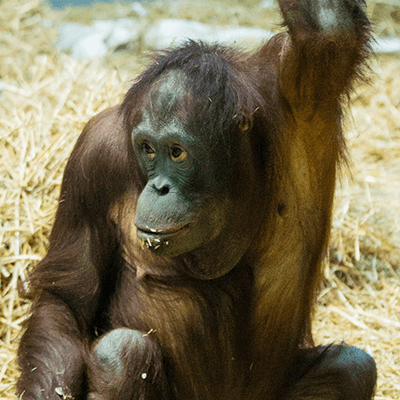
•Orangutans are found in Asia on the islands of Borneo and Sumatra.
•They are the only great ape in Asia.
•Orangutans share 97% of their DNA makeup with humans.
•Orangutans are almost completely arboreal in the wild. That means they live in the trees and rarely come down to the ground.
•Like birds they build nests! Unlike birds, their nests are built each night to sleep in.
•Like humans, orangutan moms take care of their offspring for a long time - until they are about seven or eight years old! Even after offspring leave their mothers, they will often meet up and share a meal occasionally in the years that follow.
•By staying with mom even after she has a second infant, female orangutans learn how to care for their own offspring.
Why are Orangutans an Endangered Species?
Unfortunately, orangutans are losing their primary rainforest habitat every day due to pressures like mining, logging and development of palm oil plantations. Sadly, there are estimated to be only about 50,000 Bornean Orangutans and 7,000 Sumatran orangutans left in the wild. If they continue to lose their home, they may go extinct in the wild during our lifetime.
How We are Helping
Henry Vilas Zoo participates in orangutan conservation projects with all the major orangutan rehabilitation centers in Indonesia. According to Ronda Schwetz, Deputy Zoo Director and Field Advisor for the Orangutan SSP,
"Henry Vilas Zoo is pleased to be organizing this year's zoo professional exchange with the National Zoo in Malaysia by bringing over eight orangutan experts, each from a different AZA accredited facility."
How YOU Can Help
To make a donation to support Henry Vilas Zoo's conservation initiatives, please call (608) 258-9490.
Learn how you can avoid using palm oil products.
About Orangutan SSP Field Trips
Formed in 1988, the Orangutan SSP is a group of dedicated professionals with five primary goals:
- Ensuring the genetic and demographic health of the captive population
- Advancing the care of captive orangutans
- Engaging in research to help learn more about orangutans and their care
- Educating the public about critical orangutan issues
- Partnering with other organizations that seek to improve the lives of wild and captive
orangutans
In 2011, the Orangutan SSP and REACT teamed up together to work in Malaysia. Eight keepers and one vet visited Zoo Negara (the Malaysian National Zoo) for a five-day training workshop, and also delivered enrichment to the chimpanzee and orangutan holding areas. This was followed by a visit to the Lower Kinabatangan to see the excellent conservation work that is taking place to conserve and study orangutans there.
Our newest orangutan: Datu
Henry Vilas Zoo is privileged to announce the recent arrival of a seven year old male Bornean Orangutan named 'Datu,' which means "noble gentleman" in Indonesian.
Datu's transfer to Henry Vilas Zoo was recommended by the Orangutan Species Survival Plan (SSP)© administered by the Association of Zoos & Aquariums (AZA). Datu has been selected to eventually mate with the Zoo's nine year old female, Kawan. Breeding plans are based on genetic pairing intended to help sustain both wild and captive populations of this highly endangered species.
We are happy to welcome Datu to our family!